
Building confidence in proactive design
When new opportunities emerged on a federal data modernization contract, I led the design team to grow within their roles and answer the call.

HCD Team Lead
Role
Medicaid Data Operations
Project
A1M Solutions
Company
2026
Year
Medicaid itself is not a single program. It is federally authorized, state-administered, and locally implemented through many independent systems, each shaped by state policy choices, delivery models, and operational constraints.
The Transformed Medicaid Statistical Information System (T-MSIS), part of the Centers for Medicare and Medicaid Services (CMS), is the mechanism that makes Medicaid data visible at a national level so it can be used for oversight, program integrity, policy analysis, and research. This includes receiving state-level operational data, translating it into a standardized federal reporting structure, and monitoring the quality of the data reported.
Problem
The T-MSIS program was missing the benefit of a mature, proactive design process that helps determine which needs and which problems should be prioritized and how those priorities should be addressed.
The stakeholders from CMS did not come from a product development background, so they were largely unaware of the value being left on the table.
Opportunity
Showcase the value of Human Centered Design and increase stakeholder investment in the design team.
Design process highlights
Workshop facilitation
I facilitated a series of workshops where the team applied their design skills to their own workflows.
User analysis
To ground our thinking, we identified specific CMS stakeholders the team worked with on a regular basis and prioritized them according to their influence on the program and our opportunity to win them over.

Prioritizing stakeholders in our audience
We brainstormed ideas about what those stakeholders want and value, then created an affinity map that clustered them into five main categories.
Progress
Efficiency
Risk reduction
Organizational reputation (positioning T-MSIS positively within larger CMS)
Personal sentiment (feeling their input was heard and appreciated)

Affinity map of stakeholder priorities we can use to frame the value of design work
Service design
Once we had a sense of how to frame our work for maximum impact, we discussed when and how we could make use of that framing.
What was the best medium for sharing?
When was the right time to share?
How should that work be positioned at various stages?
How should we prompt people to engage?
We also identified potential risks that could limit our ability to follow through on plans to share work for maximum impact. The most significant risk was the amount of time required to prepare effective demos, artifacts, etc. We planned to mitigate that risk by making it explicit in our work plans (i.e. Jira issues) to ensure there was adequate time available. I also encouraged designers to pair with colleagues for demos so their contributions to working code would be more visible.
Solution and impact
The ideas and strategies established at our workshop went on to initiate a major shift in the HCD team's role at T-MSIS. The change did not happen overnight, but the output of that workshop formed the backbone of continued conversations about effectively showcasing the impact and value of design work.
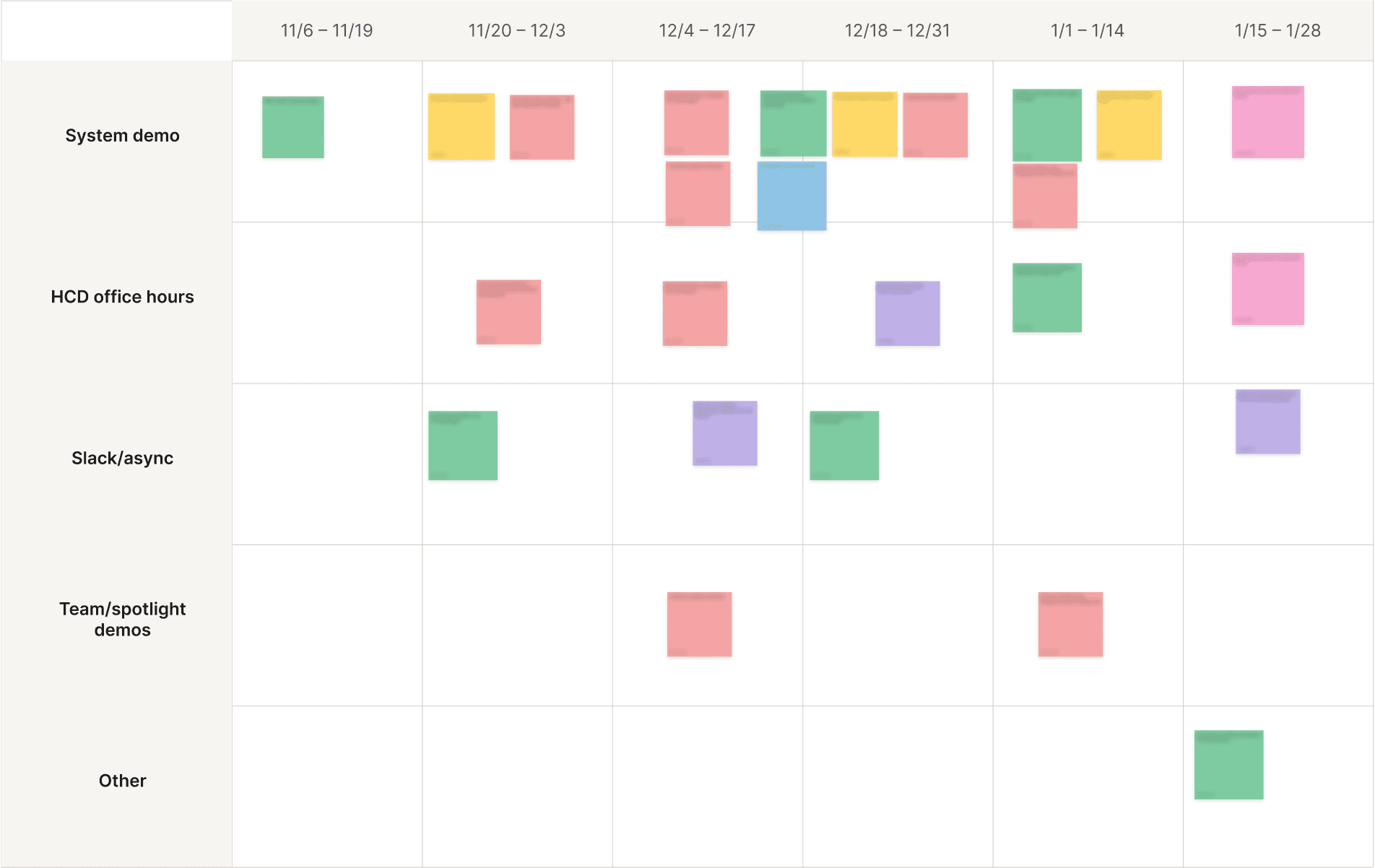
We followed up on the workshop by tracking when and how each member of the team was showcasing their work on a regular basis
Members of the team moved beyond just attaching wireframes to tickets and started conveying the more nuanced aspects of their craft. They focused on sharing the "why" behind their design decisions and the outcomes they drove in a way that was explicitly tied to stakeholder priorities.
They also started sharing their work more frequently, and this did more than just speak to stakeholder interests. It helped deliver on them. When designers started sharing work earlier, it helped identify issues, misunderstandings, and misalignments. This allowed the program to refine ideas and iterate before development began, rather than requiring the costly rebuilds that were the norm when issues weren't surfaced until code demos.
Altogether, these changes steadily built stakeholder confidence and allowed the team to contribute in new and exciting ways. Content strategists were able to streamline their review processes. UX designers were able to embrace a dynamic where stakeholders focused on sharing needs or concerns and trusted the design team to validate those ideas and propose effective solutions. To sum it up, it became a lot more common to hear CMS stakeholders respond to questions with "Well, what does the HCD team think?" and the HCD team was ready to answer.

